

As in the personality type, not the office equipment or 80s movie
Scanners are people who have a wide variety of interests and passions and are curious about many topics, finding it hard to focus on one thing. A type of person who can't help but ‘scan’ the horizon, eager to discover their next juicy interest, instead of ‘diving’ deep into a single path as a Specialist.
This term was coined by American author, speaker and coaching pioneer -and full disclosure: also my original coaching mentor - Barbara Sher (1935-2020). Barbara had a gift for recognizing patterns in people, and offering advice and encouragement to live life on their own terms.
In her 1994 career guidance book “I Could Do Anything If I Only Knew What It Was” she described a number of personas, one of which she called Scanners. Her description of this type resonated with many of her readers. They wrote to Barbara asking her to say more about what she observed.
The 2007 book “Refuse to Choose” was her response. It was a guide for individuals who were struggling with ‘loving too many things’ and ‘not directing their learning towards a goal.’
While having many passions might not seem like a liability to a casual observer, her readers and clients were conflicted. They’d wrestle with thoughts like,
“I can never stick to anything.”
“I lose interest in things I thought would interest me forever.”
“I keep going off on another tangent.”
“I won’t choose a career path because it might be the wrong one.”
“I’ll never be an expert in anything. I feel like I’m always in a survey class.”
… and so on.
While she sympathised with these thoughts, she intuited that there was more to understand about this group of people — their shared qualities, frustrations, and most importantly, what they could do to thrive.
Researching historical figures and observing her own clients, Barbara theorised that Scanners were hard-wired (born with a strong leaning) to pursue many topics and variety in life. Variety was always been a strong trait for species survival. It's helped us proliferate across the planet over hundreds of thousands of years. But living in an era and predominant culture that values narrow specialization, and surrounded by people who couldn’t relate to this struggle, Scanners were left feeling isolated and defective.
The core struggle of Scanners was not from having too many interests, but from internalized societal pressure to specialize and commit to a single career path. In her generation, she referenced the launch of the Russian spacecraft Sputnik, noting how American educational culture, till then focused on developing character, started scrambling to exalt specialists to accelerate their own cosmic ambitions.
In our own post-iPhone, AI-proliferated era, specialists remain high status as the purveyors of power and gatekeepers of complexity. But does that make broad generalists any less intelligent, valued or useful to society? Barbara thought quite the opposite.
One of her core beliefs was this: whatever unique qualities we inherited from our genes, they were not just for our personal benefit (or detriment). Acknowledged and applied constructively, our individual traits served a purpose for the resilience of the species itself. We owed our gifts to the world, and to under-value or under-use them was to squander these gifts.
This idea is confronting to many. Too often we give up on ourselves, having already decided ‘what’s the point?’, certain that our impact on the world will be negligible or burdensome. But exactly how useful or inspiring we are or will be to others is not knowable or up to us. To use our innate qualities with respect and joy is in itself a demonstrated utility.
“Refuse to Choose” offered insights, strategies, and practical methods for embracing a multifaceted life without guilt or confusion. Barbara validated the unique joys and frustrations experienced by these particular types of minds. She encouraged Scanners to embrace their natural tendencies and find customized, practical ways to work with them, rather than force themselves into conventional roles.
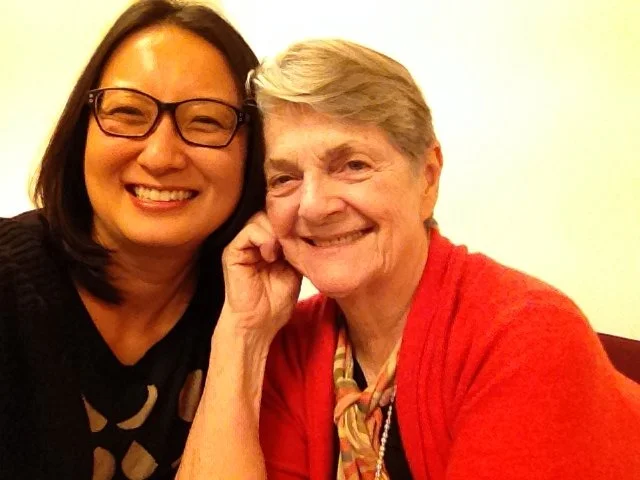
With Barbara Sher, Amsterdam 2013
Scanners and ADHD
By now some of you may be thinking Scanners are just ADHD. But Barbara was clear that she was onto something else. Both her concept of a Scanner and features of Attention Deficit Hyperactivity Disorder (ADHD) describe patterns of behaviour involving varied interests and attention, but that’s where the parallels end.
When I first read about the Scanner type in '“I Could Do Anything…” in the 90s, I related right away. Later in the mid-00s I also suspected being on an ADHD spectrum after connecting the behavioural dots from childhood to adulthood. By then I was more interested in learning how to work with my traits, rather than take up time in a clinician’s office.
Barbara herself was diagnosed with ADD in the 1980s (at the time well into her 50s) but did not fold her Scanner definition into it. In her trademark nonconformist style, she refused to adopt a pathological self-image. Nor did she pine for the world to bend to meet her reality.
Scanners were part of a set of typologies Barbara developed, describing a positive non-pathological personality type that thrives on learning and possesses a natural propensity for varied interests.
ADHD on the other hand is “a neuro-developmental condition defined by specific clinical criteria in the DSM-5.” As a condition, it’s focused on pervasive and impairing symptoms like inattention, hyperactivity, and impulsivity that need management due to significant impact on daily functioning.
Understanding this difference is crucial for identifying when a love for learning and huge range of interests is an unusual but healthy personality trait, versus when debilitating behaviours need clinical intervention.
Barbara noted that while some (not all) Scanners had ADHD, not everyone with ADHD were Scanners. The condition of ADHD, though it required special attention, did not amount to making a person especially interesting. On the other hand, Scanners’ ranges of interests and experiences were what made them inherently unique, fascinating and valuable, and she heeded their call for encouragement and sensible guidance.
Is there an assessment for Scanners? No, because it’s not a clinical diagnosis. “Refuse to Choose” features questionnaires and anecdotes that you’ll either recognize in yourself or not. It’s an intuitive, relatable description of a personality trait.
Other terms for Scanners
Over time, other words have entered the vernacular to describe this persona. There’s multipotentialite, a term I never quite took to using, because Barbara’s term is descriptive of the present behaviour itself, rather than implying future value with ‘potential’. As a honey bee that darts from bloom to bloom isn’t showing its potential, a Scanner is behaving the way they’ve evolved.
There’s also Renaissance Soul, While this term is meant to conjure up the era when broad learning was a power move, it suggests that this trait was chiefly present and relevant for a specific time long past, which IMO, it’s not. Also, Renaissance Soul’s just too strongly associated for me with grassy fairgrounds, lutes and brown velvet tunics so… I’m still partial to Scanner.
But the term Scanners is not without its own complications. Barbara’s book came out a few years after a certain David Cronenberg movie with the same name, famous for its ‘mind-blowing’ special effects. It turns out Barbara didn’t find out about the semantic collision until after she published her book (pre-internet, people).
Paradoxically, the label Scanners was created precisely because we’re so much more than our labels. Identities are best held lightly, because while they can make us feel seen they can also limit us from existing unconventionally outside its perimeters.
We’re still imperfect human beings in the world, cracking on with our own unique advantages, struggles and opportunities one day at a time. No matter what term you give your way of being, you can always grow and flourish by better knowing who you are, how you see yourself, what makes you tick and what you need.
I receive zero kickbacks for recommending books. Please support your independent book sellers by visiting their shops in person, or on Bookshop.org for US and Bookshop.co.uk in Europe.